
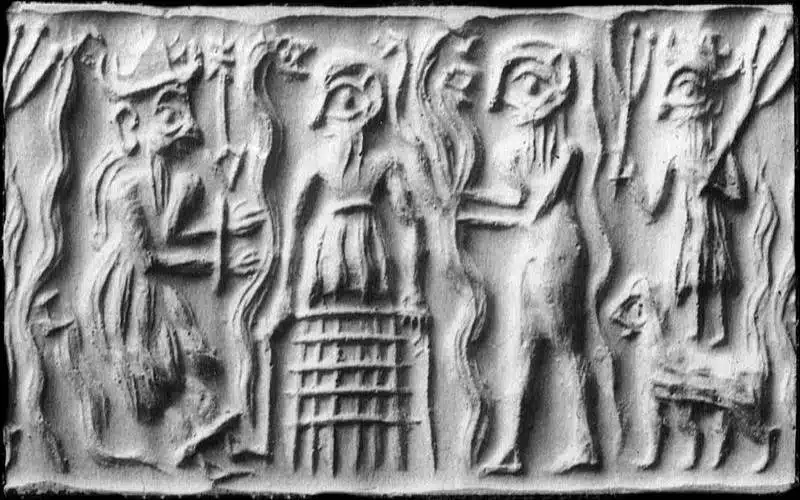
The goddess Inanna, called the Queen of Heaven in Ancient Sumer, and the progenitor of the goddesses Venus and Aphrodite, tricked the God of Wisdom Enki, her father, into giving her his special tools, including the valuable Tablets of Destiny, which gave her great powers.
Inanna managed to do so by getting Enki drunk, and by the time he got sober, she was gone. Enki tried to get his tools back, but with no success, so he accepted the defeat. Inanna was now all-powerful, but she felt very isolated and lonely.
Inanna’s Marriage and Visit To the Underworld
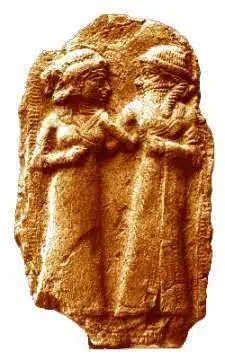
Inanna soon had two suitors—one a farmer named Enki (short for Enkidu) and the other Dumuzi, a shepherd. Both gave her beautiful gifts, but Dumuzi’s sumptuously soft woolens gave him a distinct edge.
Inanna was worried about her sister, Eriskegal, and decided to visit the Underworld to see her. Eriskegal’s husband, the God of Death, had recently deserted her. Though the goddess Inanna felt concerned about her sister, she dreaded the trip. After all, the two sisters had never gotten along very well.
When Inanna arrived at each of the seven gates of the Underworld, the gatekeeper demanded she leaves one of her garments. He required her to leave her jewels and even her crown.
The Betrayal
When she finally saw her sister, the goddess stood before her, naked and vulnerable. And Eriskegal was angry with her, feeling that Inanna had not been supportive of her, hadn’t even visited before now. So, Eriskegal flew into a rage and killed her on the spot.
Inanna had been foresighted enough to advise her servant that if she did not come back, he should mount a rescue attempt. When she didn’t appear, he appealed to Enki, her father, who sculpted two tiny creatures from the clay beneath his fingernails and sent them into the Underworld with the servant, carrying magical substances called the Food and Water of Life.
The creatures soon came upon Eriskegal, who was deep in grief, mourning the loss of her beloved husband. They were quick to acknowledge her pain and comfort her with kind words.
Eriskegal was so touched by their concern that she offered to give them anything they wanted. They asked for the corpse on the wall, and soon they were feeding the lifeless Inanna the Food and Water of Life. Revitalized, Inanna requested that she be allowed to return to the world. Eriskegal consented, but only on the condition that someone return to take Inanna’s place.
7 Seals of Inanna
Inanna ascended through the seven gates, collecting all of her possessions as she went. With her crown once again upon her head, she exited the underworld and returned home to find that, in her absence, her beloved Dumuzi had usurped her throne. In a fit of rage, she sent him to take her place in the land of the dead.
Inanna’s Annual Descent
After cooling off a bit, Inanna decided perhaps she had been a bit rash and went to get him back. Since she now realized that Inanna’s visit had been to express compassion to her, Eriskegal agreed to let Dumuzi return home—but for only half of each year.
Each year Inanna must descend again into the Underworld to resurrect her consort and renew her vitality. Given new life by his consort, Dumuzi returned to earth as the God of Vegetation. Fortunately, he was allowed to return to earth each spring in time to ensure the fertility of the land.
Legacy
At each gate, Inanna was required to shed a piece of her identity—a possession that symbolized an important role or relationship in her life, a part of her identity, the face she showed to others. One of the important lessons of the goddess Inanna is that if we are to remain in touch with our true selves, we must surrender our attachments to the “outer world” and travel inward.
The goddess Inanna represents the many facets of being a woman and the importance of roles they each play in living a full life. She is a powerful example of a courageous way of being. She is unafraid to face the challenges and changes that are required during the course of life. As one who courageously traveled into the dark places of the soul, she can be our guide in times of tribulation.
Inanna Symbols
The goddess Inanna is often represented by symbols associated with her distinctly feminine but courageous, wise, and just nature or with her association with death and resurrection.
The Mesopotamian goddess Inanna is associated with fertility, politics, and war, so her symbols are equally varied and cover lots of ground.
General
Eight-pointed stars are one of the most powerful symbols across several religions. They symbolize life, fertility, and protection against evil. Eight pointed stars also symbolize Innana’s travel to the underworld and the gates where she had to leave her belongings.
Other symbols for Innana are rosettes, scepters, wool, apples, mirrors, a knot of Inanna, and a crown.
Animals
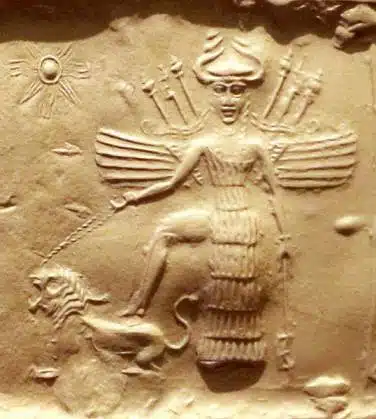
Lions are often associated with courage and grace, both of which are the characteristics of Innana. After all, it took a lot of courage to descend deep into the Underworld and face your ill-tempered, estranged sister!
Other animal symbols of Innana are doves, bats, butterflies, and snakes.
Plants
Lilies were often associated with various goddesses and female saints due to their elegance, grace, and delicate appearance. Lilies also symbolize purity, innocence, and rebirth, and Inanna is associated with all of them.
Other plant symbols of Inanna are narcissus, reeds, myrtle, and sumac, all sprout and spring growth.
Perfumes/Scents
Since Inanna is symbolized by the lily plant, the Lily of the Valley scent is the perfect choice to symbolize her. Other perfumes and scents that can symbolize Inanna are lotus, myrrh, lilac, and lime.
Gems and Metals
Gold is a precious metal with many symbolic meanings. It is associated with royalty, riches, good fortune, good luck, longevity, rebirth, and fertility. As such, it is a perfect symbol for Inanna.
Other gems and metals that symbolize Inanna are ruby, emerald, obsidian, and andalusite.
Goddess Jewelry
There are many reasons why you might want to keep a healing crystal or stone close to you. Getting closer to your goddess by wearing her color or crystal is a great one. That they also look great as jewelry only makes it so much better!
Here is a guide to crystal jewelry you hopefully will find helpful. In it is a list of 30+ crystals and links to some really great looking jewelry with that crystal or stone. Enjoy!
Colors
Green, black, red, silver, and white are all powerful and popular color symbols for Inanna.

“Have you tried the Goddess Quiz yet? Are you an Artemis goddess archetype, or maybe you are more like Demeter? Find out now!”
Embracing the Call of Inanna: Recognizing Her Presence and Cultivating a Sacred Connection
Have you ever felt drawn to the mysteries of love, fertility, and the heavens? For many spiritual seekers, the Sumerian goddess Inanna may be extending an invitation to connect. Discover how to recognize the signs of her calling, invoke her presence, and cultivate a meaningful relationship with this powerful ancient goddess.
How to know if Inanna is calling you
One way to recognize Inanna’s call is through symbols associated with her. Encounters with lions, doves, or the eight-pointed star may be signs. Keep an eye out for any symbols that seem to resonate with you, as Inanna often communicates through these sacred images.
Dreams and visions are another way Inanna may reach out. Dreams featuring her, her symbols, or themes of love and fertility can be significant. Similarly, visions of celestial bodies or an all-encompassing warmth might signal her presence.
Finally, pay attention to synchronicities in your life. Repeated encounters with her symbols, or a strong attraction to her stories and mythology, can indicate that Inanna is calling you. These patterns may seem coincidental, but they’re worth noting.
Invoking Inanna
To call upon Inanna, choose a location that evokes the heavens or create an indoor space inspired by celestial themes. Incorporate her symbols, such as the eight-pointed star, lions, or images of her into your chosen area. This will help establish a connection with the goddess.
During your ritual, light candles, particularly gold or red, as they represent her divine and passionate nature. Offer symbols of Inanna, such as flowers, tokens, or even written intentions. These offerings demonstrate your dedication and respect for her.
In meditation, focus on your breath and clear your mind. Visualize Inanna, her symbols, and the energy she embodies. Quietly ask for her guidance, and be open to any insights that may arise during your meditation.
Signs that Inanna is present
Recognizing when Inanna is with you is essential to deepening your connection with her. The goddess often manifests her presence in various ways, from emotional sensations to visual cues. Here are six signs to help you identify when Inanna is near:
- Emotional sensations: Feelings of warmth, passion, or empowerment can indicate her presence.
- Physical reactions: Sudden warmth, tingling sensations, or a sense of lightness may signal she’s near.
- Visual cues: Flashes of golden light, celestial imagery, or glimpses of her symbols can be signs.
- Auditory cues: Hearing whispers, gentle breezes, or distant music may suggest her presence.
- Nature occurrences: Unusual encounters with lions or doves can be a signal.
- Intuitive connection: A strong sense that Inanna is with you, even if you can’t pinpoint why, can be a sign of her presence.
Cultivating a relationship with Inanna
To build a deeper connection with Inanna, establish a consistent practice of meditation, prayer, or ritual to honor her. Make regular offerings, such as during the full moon, to demonstrate your commitment to the goddess.
Embrace her values by nurturing love, fertility, and compassion in your life. Protect and honor the heavens and celestial bodies, as these aspects are central to her being. Aligning your life with her principles will help deepen your connection to her.
Lastly, study her mythology and history. Read about Inanna and her place in Sumerian mythology, and engage with others who share your interest. By exchanging insights and experiences, you’ll develop a richer understanding of the goddess and strengthen your bond with her.
Inanna’s Meditations
- Help me, Inanna, to be more like you, flexible with a wide open mind.
- Guide me, Inanna, to master self-expression so that I may reveal the beauty that I so often appreciate in secret.
- Great Inanna, help me to continuously be open to learning and growing.
- Lend me your powers, Inanna!
- Inspire my imagination, Inanna, so that I may manifest what I really want in my life.
- Make me strong enough to fight for what is right, not just tolerate what life has thrown in my path.
- Help me know who I am and how I can find ways to make things better and better.
- Lead us in working towards harmony in times of distress with a focus on honor, morality, beauty, and virtue
- Inanna, remind me to take time to rest and recharge so that I may have the energy for my endeavors.
- Help us spread a worldview that inspires compassion, kindness, harmony, and beauty.
- Remind me that, like you, I, too, have the power to be compassionate while discerning and respecting what is healthy for myself.
- Remind me that, even when I am private and reserved, I can feel my deep connections to others.
- Inanna, help me to communicate deeply with others, using my intuitive and poetic gifts.
- Help me to speak to the souls of others, using creative approaches like symbols, metaphors, and parables.
- Help me value principles and values over logic or excitement-seeking.
- Inanna, help me to understand my place, my strengths, and my ideals and how I might use them to foster growth.
- Goddess, help me use my creativity and intuition to find unconventional solutions.
- Help me remain hardworking and dedicated toward my goals.
- Inanna, sometimes I feel so sensitive. Help me to respond well to constructive criticism.
Want To Bring More Inanna Qualities Into Your Life?
- Focus on finding the sense of meaning in your experiences and then share the depth of human understanding you find in pursuing your passions and following your bliss. Write poetry or creative prose, not just for the sake of pleasure but in order to share the values, harmony, and sense of well-being that your unconventional perspectives allow.
- Remember to remain open-minded and flexible. Others may find it difficult to see things the same way you do. Keep lines of communication open by being genuinely curious, and when differences in perspective and opinion are intractable, practice the art of “Live and let live.” when not in life or death circumstances.
- Be courageous. Be willing to be present and share in the struggles with others. In order to share true intimacy, we have to be willing to strive for human contact, not just social contact. You don’t need to solve or fix it; just let someone know that you are aware of what they are going through and that they are not going through it alone.
- Make sure to recharge and recenter. It is important, periodically, to remove yourself to somewhere that brings the focus back on yourself in order to process feelings and experiences, then glean their meaning and importance.
- Enjoy the sensual pleasures to be had in the arts. Engage in the creation and enjoyment of beautiful music, theater, photography, and all visual arts.
- Notice what changes need to be made. Life is changing, and being able to be proactive is a true blessing. Pay attention when you start sensing discomfort and ponder what steps can be made that head toward positive change. Start taking those steps and remain in the process.
Other Goddesses
If you enjoyed this post we are sure you will enjoy getting to know some of the other goddesses we also write about. You can find the complete list of goddesses sorted across regions and religions here.
Featured Image Credit: Via Wikimedia Commons


