
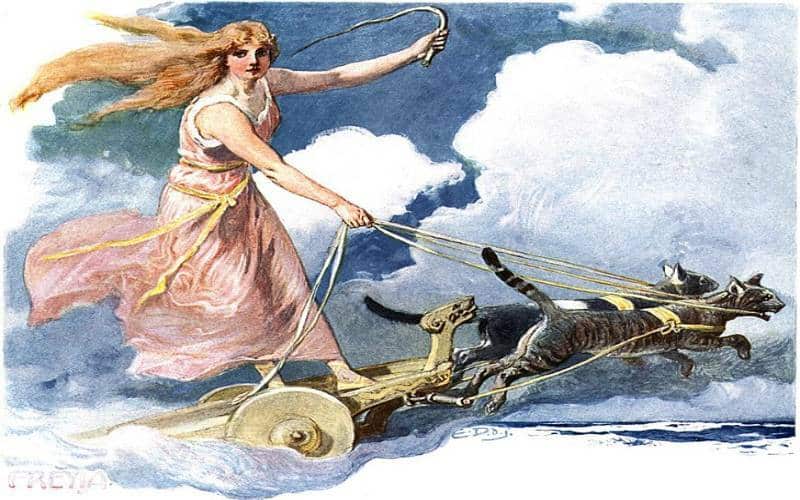
Freya is a warrior goddess, a Valkyrie, and a goddess of sensual love, fertility, beauty, and gold. Though this captivating goddess from ancient Norse myths had numerous lovers, she was the wife of the mysterious Norse god Od.
Freya was a spectacular beauty known for her appreciation of romantic music and stunning floral arrangements. That was her softer side; she was also known as the goddess of war and death.
Freya’s name was “The Lady” or “mistress,” and this name could be the source of our name for the fifth day of the week, Friday. With her twin brother, Freyr (“The Lord”), these divine twins were the Norse deities of untamed nature. Possibly a sign of who was the most popular, Freyja is in use as a girl name in parts of Scandinavia today. Freyr however is exceedingly rare as a boys’ name with Norse roots today.
On The Battlefield
As the leader of the Valkyries, she had considerable power. She had the right to claim half the souls of the bravest warriors who died in battle. By actually going onto the battlefield, she would gather them up and take them back with her to spend the after-life in her home in perpetual rest and recreation. A sweet and generous woman, she always invited their wives or lovers to come and live with them.
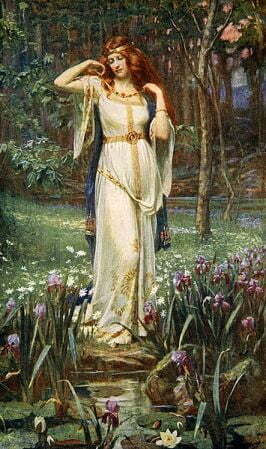
The other half of the heroic warriors, who belonged to Odin, would be gathered up by the Valkyries and taken to Valhalla, where they were able to live in comfort and honor.
She was also called upon to comfort those who were dying, to ease their transition into Valhalla (the “otherworld”), serving as a guide and companion on the journey to Valhalla for many Viking heroes who had died nobly.
When Freya and the Valkyries rode forth on their missions, their armor caused the eerily beautiful flickering light that we know as the Aurora Borealis, or Northern Lights.
Freya’s Marriage to Od
Freya was married to Od. Freya and Od were wed, but soon after their wedding, Od disappeared, and all feared that he was dead, perhaps killed by the ruling deities for disobeying their orders.
Freya was distraught and cried tears of gold but refused to accept that he was dead. Putting on a magical cloak made of falcon feathers that allows the wearer to fly across vast distances very quickly, she rose into the sky and searched all over the earth for him.
Indeed, Od had not died but had been banished and lost at sea. When Freya found him, he had already degenerated into a sea monster. Hideous as he appeared, Freya stayed by his side and comforted him.
When someone stumbled upon the sea monster and killed him, Freya was enraged and threatened to take her revenge for slaying the noblest of the gods. Fortunately, it all worked out as Od was admitted to Valhalla even though he had not died in battle and was allowed to have conjugal visits from Freya so that the two were never separated by his death.
Freya’s Numerous Affairs
Freya had many other lovers, although she deeply loved her consort Od. (Remember, monogamy had not been invented yet, and infidelity was the social norm.) Aphrodite‘s amorous escapades pale in comparison with those of Freya, whose unbridled sexuality was legendary.
Usually depicted as a strawberry blonde with stunning blue eyes, none could resist her. To make matters even worse, like the Greek goddess Aphrodite, she possessed apparel that made her irresistible to men, a magical necklace reputedly made of amber and rubies that was called a “brisling” or “brisingamen.”
The goddess Freya’s passions were abundant, vigorous, and unrestrained. Clothed or not, she was usually shown in sensual poses.
How Freya Got Her Necklace
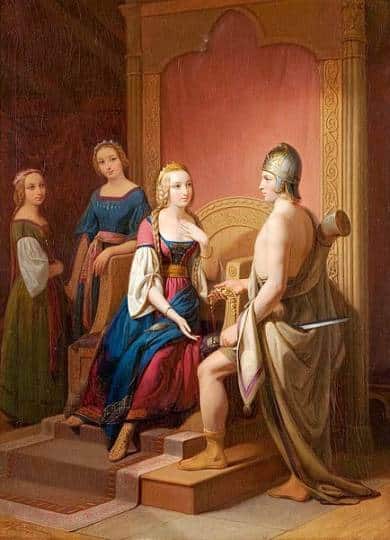
Freya had left it a bit late to leave her friend’s house to start home. The sun has set, and it began to snow. Soon, she was becoming disoriented and frostbitten. Luckily, she was found by four dwarves who rescued her and took her to their home. The dwarves were named “North, South, East, and West”.
Freya volunteered to pay them for their hospitality, and the four dwarves cheerfully agreed. They asked to be repaid by having her sleep with each of them for one night. Freya wasn’t at all interested and promptly declined until one thing changed her mind.
She saw the incredibly beautiful necklace that they had just made. She had to have it and offered to return after the storm and pay for it in gold. They may have been dwarves, but they weren’t stupid. They told her it was not for sale at any price. However, countered with an offer that they would be delighted to simply give it to her if she were willing to pay their price for her room and board during the storm.
When Freya returned home after the storm subsided, she wore the stunning “necklace of desire.”
Aesir–Vanir War and Possible Marriage To Odin
Freya belonged to the Vanir group of gods that were often associated with fertility, wisdom, and the ability to see the future. However, there was another group of gods, Aesir. This group of gods was more focused on fighting wars, and soon enough, the war happened.
Not much is known about the Aesir–Vanir War, except for the fact that there was a peace treaty that included the exchange of hostages. As a part of the peace treaty, some myths have it that Freya was married to Odin, who belonged to the Aesir group of gods. In other more established mythology Odin is married to Frigga, and Freya and are two separate goddesses.
Freya’s Cats
She is often depicted riding her golden chariot through the skies, the chariot pulled by two large blue cats who were a gift from the Norse god Thor. It’s a popular belief today that the Norwegian Forest Cat breed descends from Freyjas cats.
Freya chastised Thor soundly one morning for awakening her from her beautiful sleep with his boisterous and noisy preparations to “go fishing” for a sea dragon. While he was on the way to his fishing spot, Thor kept hearing lovely song-like noises that seemed to be lulling him to sleep.
Stopping to investigate the source of the odd sounds, he found them coming from a nest of mewing blue kittens being tended by a tomcat. The sound that Thor had heard was the male cat singing to the kittens, “Sleep, sleep, my dear little ones.”
Thor suggested (in forceful terms) that the cat stop singing the lullaby and the cat sassed him back, suggesting that Thor had no idea how difficult it was for a single-parent male to rear his children and asking if he knew any women who would be willing to take them in.
Immediately Freya came to mind, and Thor agreed to take them to her. Like all cats, this one was not quick to show appreciation and added that being blue, they were unique cats and deserved an especially fine home. Thor took offense at the comment and thundered back at the cat, who, not the least impressed, bared his claws and then turned into a bird and flew away.
Legacy
Although the story of Freya’s adventure with dwarves might seem obscene by today’s standards, it is actually a good lesson. In archetypal psychology, dwarves often represent the parts of self that we have neglected or even rejected.
The story of goddess Freya sleeping with dwarves reminds us to explore and acknowledge all of our emotions, longings, and traits, even those we wish we didn’t possess. Just like sleeping with dwarves got Freya the most beautiful necklace, exploring and acknowledging our hidden emotions can bring many good things to our lives.
“Have you tried the Goddess Quiz yet? Are you an Artemis goddess archetype, or maybe you are more like Demeter? Find out now!”
Freya Symbols
Freya is a warrior goddess, but she is also the goddess of sensual love, beauty, passion, and fertility.
General
What else could be a better symbol of Freya than Aurora borealis (the Northern lights)? Northern lights are beautiful, breathtaking, and truly magical, and as such, it makes no wonder that they symbolize Freya.
Freya’s other symbols are swords, floral bouquets, and romantic music.
Animals
Geese symbolize joy, guidance, new ideas, productivity, wisdom, teamwork, determination, and reliability. All of these characteristics can be traced back to Freya, and that’s why geese are such a good symbol for her.
Freya’s other animal symbols are sparrows and horses.
Plants
Apple is one of the fruits with the most symbolic meanings. Apples represent beauty, love, passion, fertility, lust, and knowledge, and this makes them a great symbol of Freya.
Other Freya’s plant symbols are bramble, cypress, thyme, vervain, and yarrow.
Perfumes/Scents
Cypress scent is herbaceous and spicy with a hint of evergreen woody scent note. Cypresses symbolize eternal life and spirituality, and they ar often used as symbols of Freya. Vervain is another scent that represents this goddess.
Goddess Jewelry
There are many reasons why you might want to keep a healing crystal or stone close to you. Getting closer to your goddess by wearing her color or crystal is a great one. That they also look great as jewelry only makes it so much better!
Here is a guide to crystal jewelry you hopefully will find helpful. In it is a list of 30+ crystals and links to some really great looking jewelry with that crystal or stone. Enjoy!
Gems and Metals
You can use Ruby to symbolize Freya as its red color invokes passion, love, beauty, and fertility. All the concepts associated with Freya.
Other gems, crystals, and metals that can symbolize Freya are citrine, red jasper, jade, malachite, and copper.
Colors
Red and black are definitely Freya’s colors, as these colors can represent love and passion, but they can also represent war and death. This makes them perfect colors for Freya, as she is the goddess of love and fertility, yet she is the goddess of war too.
Embracing the Call of Freya: Recognizing Her Presence and Cultivating a Sacred Connection
Have you ever felt a strong affinity for love, beauty, or even the battlefield? If so, it’s possible that the Norse goddess Freya is beckoning you to connect. Discover how to recognize her call, invoke her presence, and foster a meaningful relationship with this powerful deity.
How to know if Freya is calling you
Freya often sends her call through symbols of love, fertility, and war. Keep an eye out for cats, as they are her sacred animals and may represent her presence.
Dreams and visions featuring Freya or her symbols, like her necklace Brisingamen, can also be significant. Additionally, gold or amber light in your visions might signal her presence.
Finally, pay attention to synchronicities in your life. Repeated encounters with her symbols or a strong attraction to her stories and Norse mythology can indicate Freya’s call. These patterns might seem coincidental, but they are worth noting.
Invoking Freya
To call upon Freya, create a space that reflects her attributes of love, beauty, and war. Incorporate symbols like cats, gold, and her necklace Brisingamen into your chosen area to establish a connection with the goddess.
During your ritual, light candles, particularly gold or amber, as they represent her divine light. Offer symbols of Freya, such as flowers, tokens, or even written intentions, to demonstrate your dedication and respect.
In meditation, focus on your breath and clear your mind. Visualize Freya, her symbols, and the energy she embodies. Quietly ask for her guidance and be open to any insights that may arise during your meditation.
Signs that Freya is present
Recognizing when Freya is with you is essential to deepening your connection. The goddess often manifests her presence in various ways, from emotional sensations to visual cues. Here are six signs to help you identify when Freya is near:
- Emotional sensations: Feelings of love, passion, or courage can indicate her presence.
- Physical reactions: Sudden warmth, tingling sensations, or goosebumps may signal she’s near.
- Visual cues: Flashes of gold light, shadows moving, or glimpses of her symbols can be signs.
- Auditory cues: Hearing whispers, rustling leaves, or animal sounds may suggest her presence.
- Nature occurrences: Unusual animal encounters, especially with cats, can be a signal.
- Intuitive connection: A strong sense that Freyja is with you, even if you can’t pinpoint why, can be a sign of her presence.
Cultivating a relationship with Freya
To build a deeper connection with Freya, establish a consistent practice of meditation, prayer, or ritual to honor her. Make regular offerings, such as during the full moon, to demonstrate your commitment to the goddess.
Embrace her values by nurturing love, beauty, and courage in your life. Protect and honor nature and its creatures, as these aspects are central to her being. Aligning your life with her principles will help deepen your connection to her.
Lastly, study her mythology and history. Read about Freya and her place in Norse mythology, and engage with others who share your interest. By exchanging insights and experiences, you’ll develop a richer understanding of the goddess and strengthen your bond with her.
Other Goddesses
If you enjoyed this post we are sure you will enjoy getting to know some of the other goddesses we also write about. You can find the complete list of goddesses sorted across regions and religions here.
Featured Image Credit: Emil Doepler, Public domain, via Wikimedia Commons


