
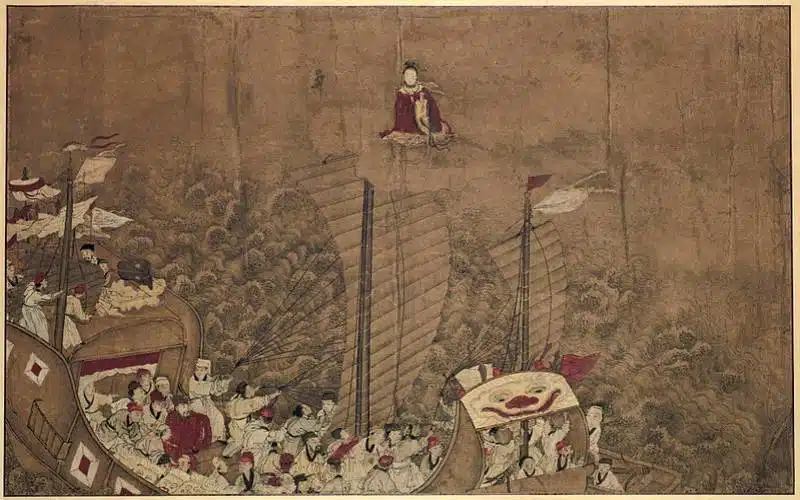
The Goddess Mazu’s stories even come to us in an unusual way. Usually, we have to search the works of poets and philosophers, historians, and anthropologists, when wishing to explore the myths of the legendary ladies we call goddesses.
But ancient government edicts, court documents, Taoist scriptures, and even shipping logs provide the stories of the young girl and the goddess she became. The goddess Mazu, even after a millennium has passed, is arguably one of the most worshipped in the world. There are over 1,500 active temples and 100 million devotees across the world.
The Origin of Mazu
The Chinese goddess Mazu has many names and titles. Known in different regions as Matsu, Ma-Tsu, A-ma, Tianhou, and other names. She has numerous titles including “Kuan Yin of the Southern Sea,” “Daughter of the Dragon,” and “Empress of Heaven.”

Some experts feel she may be a version of the older goddess Kuan Yin . She is also better known in most western countries. Mazu however is deeply rooted in the hearts of her people, especially in coastal areas in the East. There she is best known as the “Goddess of the Sea.”
In folk tradition, it is believed that when facing great difficulty, you can call her by the name “Mazu”. Then she will immediately come to your rescue. If, however, you address her as the “Empress of Heaven,” she will have to take time to put on her fine clothing and will be delayed in coming to your aid!
The History of Mazu
The Chinese goddess Mazu originated with the deification of a young woman named Lin Mo Niang. Although young she had performed numerous miracles during her short life. A kind-hearted girl with a vast knowledge of Chinese medicine, she was known as a healer. Curing the sick while teaching people how to prevent illness and injury.
Many of the miracles she performed involved quelling storms at sea, so it is hardly surprising that she is known as the protector of all seafaring people.
The Birth of Lin Mo Niang
Mazu was born on a small island in the straits of Taiwan off the coast of southeastern China in 960 A.D. Her middle-aged parents, the Lins, already had six other children, only one of them a girl. Her mother prayed to the goddess of mercy, Kuan Yin, for another daughter. Hearing her fervent prayers, Kuan Yin came to her in a dream, giving her a flower blossom to eat which caused her to conceive the next day.
The baby was named Lin Niang (in China, the family name, or surname, comes first). At her birth, the room was filled with a brilliant light and the fragrance of fresh blossoms. As a newborn, she was strangely silent. Alert and healthy, she did not cry at all during the first month of her life. This lead her parents to nickname her Mo (which means “silent”).
Lin Mo Grew Into And Unusual Girl
As she grew, it quickly became apparent that Lin Mo was gifted with remarkable intelligence and an eidetic (photographic) memory. Supernatural powers were soon to become apparent as well.
Visiting a Buddhist temple when she was four years old, Lo Min began her incredible journey of spiritual enlightenment. Standing before a statue of the goddess Kuan Yin, she was given her “second sight”. The ability to sense or “know” events that would happen in a distant time or place.
At the age of ten, she began to study Buddhism. When she was 13, she was accepted as a student by an elderly priest. He, recognizing her profound spirituality, passed on to her the secret mysteries of Taoism.
One legend ascribes her mystical powers to an event that took place when she was fifteen. Going with her girlfriends to check out their new dresses in the reflections of a pool. A sea creature erupted out of the water and was holding a bronze disk out, offering it to the girls.
Terrified, the others ran away, but the brave Lin Mo calmly accepted the bronze. From that moment on, she began to display unusual powers. These were powers that grew daily and made her a legendary figure at a young age.
Sailors and Fishermen Celebrating Lin Mo
Already held in high esteem by the villagers for her healing, Lin Mo could now predict changes in the weather. Announcing when it was a safe time for sailors and fishermen to set out to sea.
To this day, sailors from places as far-flung as China, Okinawa, Taiwan, Thailand, Vietnam, Malaysia, and even San Francisco pray to Mazu before setting out and give thanks to her upon their safe return.
Marine folklore is filled with tales of catastrophes averted when the goddess Mazu, dressed in red, appeared to sailors. This was always a warning that unseen storms were rising and that their voyages should be postponed.
Many seafarers had recounted times when the goddess Mazu appeared as a bright light on their troubled ships. Arriving just in time to calm a storm and save their lives. Some said Lin Mo could ride clouds across the ocean and appear in the flesh to rescue them.
Lin Mo Tries to Save Her Father and Brother
Though there are numerous accounts of Mazu’s many sea rescues, none is as poignant as her mystical rescue of her father and brother when they were washed overboard by a typhoon that came up suddenly while they were at sea.
Lin Mo was at home weaving a tapestry when she fell into a trance, “seeing” the events that were taking her kin to a watery grave. She used her spiritual powers to transport herself to their sides. Propelling her elder brother to safety, she returned to rescue her father.
She was swimming homeward with her father clenched firmly between her teeth when her mother noticed Lin Mo slumped over her weaving. Believing she was ill, her concerned mother woke her. Lin Mo’s trance was broken, and her father drowned. Lin Mo walked into the sea and found her father, returning three days later with his body so he could be buried at home.
In some of her myths, she was engulfed by clouds that carried her across the waves to find him. Regardless, the outcome was the same. The bereft Lin Mo intensified her quest for spiritual growth, continuing her legacy of compassion and good works, but now she seemed more distant and “otherworldly” in her grief.

“Have you tried the Goddess Quiz yet? Are you an Artemis goddess archetype, or maybe you are more like Demeter? Find out now!”
The Fight For Lin Mo’s Hand
Like Kuan Yin, the goddess Matsu decided not to marry in spite of immense social pressure to do so. Two warriors of great fame became inflamed with lust when they saw the beautiful young girl and wanted to “marry” her.
She challenged the pair to fight her for the privilege,. Insisting that they would have to do her bidding forever if she won. (Recall that learning the martial arts had long been a part of the training of Buddhist priests and undoubtedly was part of her studies as well.) You can probably imagine how that fight ended!
General Chien-li-yen (Eyes that See a Thousand Miles) and General Shun Feng Erh (Ears that Can Hear the Wind) died that day during the fight that took place on Mount Peach Blossom. To this day, the pair of defeated subordinates are seen by her side in statuary and images and as puppets in the annual processionals that celebrate Mazu’s birth.
The entourage traditionally includes guards costumed as ancient soldiers and thirty-six martial artists carrying special weapons. Tens of thousands make the eight-day pilgrimage to the oldest temple of Matsu in Taiwan each year. Countless other treks and festivals are held on her birthday throughout the regions where the goddess Mazu is still revered.
Lin Mo Dies
Lin Mo’s death at the age of 28 was as remarkable as her birth. One day she simply told her family it was time for her to leave and that she must go alone. Her neighbors and family watched as she walked to the top of a mountain near her home.
Reaching the top, Lin Mo was encircled by clouds of dense fog. Then to the accompaniment of enchanting celestial music, was carried into the heavens in a golden glow of light. Where she had been last seen, a great rainbow appeared.
The Symbolism Behind Lin Mo’s Death

In Chinese mythology, the rainbow signifies the presence of a dragon, a symbol of great blessing and good fortune. The dragon is a serpent quenching its thirst in the sea and, as a sky dragon, unites heaven and earth.
The rainbow also has special significance in Taoism — the colors represent the five Buddha families, with the color orange associated with the Bodhisattva, those who have achieved enlightenment but choose to remain on earth to be of service to their fellow humans.
Legacy
Honoring her humility and compassion, devotion, and spiritual enlightenment, following her death Lin Mo was elevated to the list of Buddhist deities and declared a goddess by the Chinese government as well.
During the millennium after her death, Imperial Courts of several different dynasties raised her status with new and grander titles. (twenty-two promotions in all) and the construction of new temples and extensive repairs to the ancient ones. Yet the true power of the Goddess Mazu, who was once the female shaman Lin Mo, is the great and abiding love of her people.
Blessed with uncommon powers, the Chinese goddess Mazu teaches us to be always mindful of the need for the reconciliation of the opposites in our lives, the need for both the masculine and the feminine, kindness and ferocity, the balance of nature and civilization, and above all, the unity of mind, body, and spirit.
Mazu Symbols
Mazu (Mat-Su) is often represented by symbols associated with the sky and sea. It is not surprising that many of our icons representing courage and compassion are derived from the ancient goddess symbols of Mazu.
General
Mazu was the patron goddess of seas and those who traveled across them. Many sailors invoked Mazu’s name when in the middle of the storm, and she helped them. This is why sea is her main symbol.
Dragons, clouds, sky, rainbow, raised fist, sea serpent, mountain tops, sailing ships, the numbers 9 and 36, mala (head-dress with a beaded veil), stone stairways (ladder to heaven), martial arts, swords and other ancient weapons, spirit flags.
Animals
In Chinese mythology, dragons were often associated with water seas, rivers, and floods. Since Mazu was the overseer of the seas, it is obvious why she was represented by a dragon.
Her other animal symbols include tigers, serpents, pigs, and deer.
Plants
In ancient China, the peach tree is a symbol of longevity and immortality. Even though Mazu lived only 28 years, she ascended to the heavens, where she became immortalized, and that’s why she is symbolized by the peach tree.
Mazu’s other plant symbols are willow, bamboo, lotus, peony, and medicinal herbs.
Perfumes/Scents
Some of the best scents to symbolize Mazu are ylang-ylang, dragon’s blood, myrrh, peony, and incense.
Gems and Metals
Pearls are the most obvious choice here to symbolize Mazu, as they come from the sea, which is under Mazu’s supervision. Other metals and gems that can be used to symbolize Mazu are bronze, pale green jade, and Shoushan stone (alabaster).
Goddess Jewelry
There are many reasons why you might want to keep a healing crystal or stone close to you. Getting closer to your goddess by wearing her color or crystal is a great one. That they also look great as jewelry only makes it so much better!
Here is a guide to crystal jewelry you hopefully will find helpful. In it is a list of 30+ crystals and links to some really great looking jewelry with that crystal or stone. Enjoy!
Colors
Mazu was often depicted as wearing orange and red clothes, and both colors symbolized happiness, joy, and good fortune. By dressing Mazu in those colors and using them as her symbols, people tried to appease Mazu to bring them happiness, fortune, and wealth.
Additionally, black and blue can symbolize Mazu.
Other Goddesses
If you enjoyed this post we are sure you will enjoy getting to know some of the other goddesses we also write about. You can find the complete list of goddesses sorted across regions and religions here.
Featured Image Credit: Rijksmuseum, Public domain, via Wikimedia Commons


